4.9 Out of 5 based on 875 reviews

Scoliosis can affect more than just the alignment of the spine. The three-dimensional changes associated with scoliosis can also affect how the muscles around the spine, ribcage and pelvis work. This can result in areas of increased muscle tension, uneven loading and differences in how the muscles support and move the body.
What Is Dry Needling?
Dry needling, or medical acupuncture, is a physiotherapy technique used to treat areas of muscle that are tight, painful or restricted. It involves inserting a fine, sterile needle into specific areas of muscle. Unlike during an injection or blood test, no fluids can pass into or out of the needle, hence the term ‘dry’ needling.
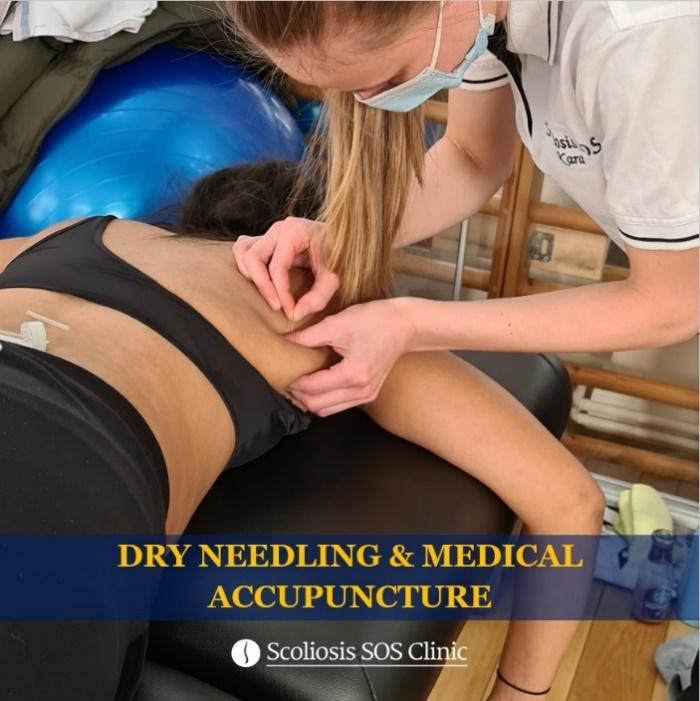
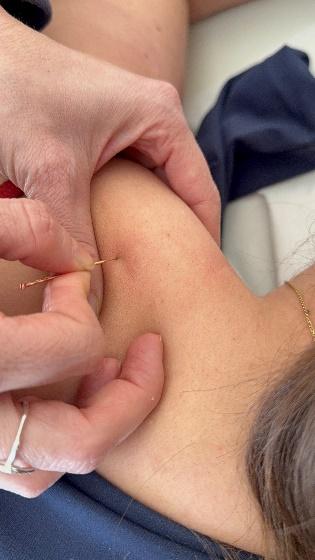
A clinician will assess the muscles and identify areas where tension or tightness may be influencing movement. The needle is then inserted into the affected muscle. In some cases, this produces a brief twitch response, where the muscle contracts involuntarily before relaxing.
For someone with scoliosis, dry needling may be considered when muscular tension is contributing to discomfort, restricting movement or making certain exercises more difficult to perform.
Dry needling may help to:
- Reduce areas of muscular tightness and discomfort
- Address local areas of muscle restriction
- Make certain movements more comfortable
- Make it easier to perform Physiotherapeutic Scoliosis-Specific Exercises (PSSE)
Dry needling is not used as a standalone treatment for scoliosis. It may be incorporated into an individualised physiotherapy programme alongside scoliosis-specific exercises, strengthening, postural training and breathing techniques. The wider treatment programme remains focused on improving posture, movement and spinal control.
How Does Dry Needling Differ from Acupuncture?
Although dry needling and acupuncture both involve the use of fine needles, they are based on different principles.
Dry needling is a modern, Western biomedical technique, dry needling is based on anatomical principles, clinical reasoning, and an understanding of how muscles and movement contribute to pain and dysfunction. It focuses on targeting areas of muscular tension to support improved movement and function.
Acupuncture, on the other hand, is based on traditional Chinese medicine principles and focuses on balancing the body’s vital energy, or Qi, by stimulating specific points along channels called meridians.
The technique also differs between them. In acupuncture, needles are inserted in specific meridian points, and are left in place for 15 to 30 minutes. During dry needling, the clinician will palpate for myofascial trigger points, or ‘knots’, to find the ideal are of insertion. From then, the needle is manipulated in a more active approach to elicit a local twitch response. It is often a quicker process.
Why Does Scoliosis Cause Muscle Imbalances?
Scoliosis can create uneven loading around the spine, causing the muscles on each side of the body to adapt differently. Depending on the individual’s curve pattern, some muscles may become shortened, tight or overactive, while others may become lengthened, weaker or less active. These changes can affect movement, contribute to muscular discomfort and make it more difficult to maintain a corrected posture.
Understanding these individual muscle and movement patterns is an important part of conservative scoliosis management. Treatment can then be tailored to address the specific areas of tension, weakness or restriction identified during assessment.
How Dry Needling Supports the ScolioGold Method
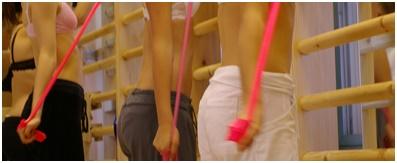
The ScolioGold Method combines Physiotherapeutic Scoliosis-Specific Exercises (PSSE) with a range of physiotherapy techniques, tailored to each patient’s curve pattern and individual movement needs. Some of the methods used within ScolioGold include the Schroth, Rigo-Schroth and FITS methods, alongside the PNF technique, postural correction and strengthening. Other techniques, including dry needling, may also be incorporated where appropriate.
Dry needling may be used where pain, muscular tension or restricted movement is affecting a patient’s ability to perform their exercises comfortably or effectively.
Some muscles can become tight or overactive with scoliosis. For example, the upper trapezius may become overactive, contributing to neck and shoulder tension or pain. Where this affects exercise performance, dry needling may be used to address the area alongside the patient’s wider programme. So, by releasing upper trap tension, the individual may become more capable of getting into a corrected posture, to there for strengthen the body in a more optimal position. Dry needling is a supportive technique within ScolioGold, rather than a treatment for the spinal curve itself.
What Can Patients Expect from Dry Needling?
Dry needling is not needed for every patient and is only considered after an individual assessment. Patients may experience a brief prick or twitching sensation during treatment, followed by some temporary soreness in the treated area. Some people may notice that their muscles feel less tense or that movement feels easier. Responses vary between individuals, and dry needling is used alongside exercise and other parts of the rehabilitation programme.
FAQs
Is dry needling painful?
Dry needling is generally well tolerated, although some temporary discomfort or soreness may occur during or following treatment. The experience varies between individuals.
Why is dry needling used to treat scoliosis?
Dry needling may be used to reduce areas of muscle tension and discomfort, helping to improve movement and make certain scoliosis-specific exercises easier to perform.
Does dry needling correct scoliosis?
Dry needling does not correct the spinal curve itself. It may instead support treatment by addressing muscular tension, discomfort or areas of restriction
📞 02074884428
🌐 www.scoliosissos.com
📷 @scoliosissosclinic
📧 enquiries@scoliosissos.com
📍 63 Mansell Street, London, E1 8AN (headquarters)