4.9 Out of 5 based on 875 reviews

Most of the time, scoliosis doesn’t appear until the patient is 10-15 years old. Scoliosis in children under 10 is rare, but it does happen on occasion.
Broadly speaking, childhood cases of scoliosis can be sorted into three different categories:
- Congenital scoliosis, where the spine is curved from birth
- Infantile scoliosis, where the curvature develops between 0 and 3 years of age
- Juvenile scoliosis, where the curvature develops between 4 and 10 years of age
What causes scoliosis in children?
Early signs of scoliosis in children include uneven shoulders and one hip/rib/shoulder protruding more than the other. Scoliosis in children is often idiopathic, which basically means that the cause is unknown. However, in some cases, the spinal curve can be traced back to genetic factors, neuromuscular disorders, injuries, infections, or tumours.
At the first sign of scoliosis, take your child to a doctor for diagnosis so that they can begin correcting the curve immediately.
Use the buttons below to see possible causes.
Select a condition to learn more about it:

Causes of Congenital Scoliosis
Congenital scoliosis occurs when a child’s vertebrae (the bones that make up the spine) develop incorrectly in the womb. It may happen because:
- One or more vertebrae didn’t form properly
- One or more vertebrae are completely absent
- Two or more vertebrae are fused together
Causes of Infantile Scoliosis
Infantile scoliosis develops very early in a child’s life, although unlike congenital scoliosis it is not present at birth. When infantile scoliosis is not idiopathic, it may be attributed to underlying conditions like:
Causes of Juvenile Scoliosis
When juvenile scoliosis is not idiopathic, it may be caused by conditions such as:
What are the risk factors for scoliosis in children?
While some cases are idiopathic, there are still some risk factors to consider for scoliosis in children. This includes:
- Age – signs and symptoms often begin in adolescence
- Gender – girls typically have a higher risk of developing worse spinal curvatures
- Family history – children are more likely to develop scoliosis if their family members also have scoliosis
- Growth spurts – sudden growth spurts can also lead to the development of scoliosis
How does scoliosis affect children’s quality of life?
Scoliosis can affect children’s quality of life, including in both physical and physiological ways. Not only can it change their appearance, i.e makes their shoulders appear uneven and/or makes them lean more to one side, but it can also affect their confidence and self-esteem. A curved spine might also incur pain and/or discomfort, which can be unsettling for children as they grow and develop.
Self-esteem is key during childhood and adolescence, which is why it is important that you arrange a consultation with scoliosis specialists like ourselves at Scoliosis SOS to learn more about how we can help your child manage their symptoms and reduce their spinal curvature.
What are the symptoms of childhood scoliosis?
The common symptoms of childhood scoliosis can include:
- Uneven shoulders
- Leaning to one side
- Visibly curved Spine
- Ribs sticking out on one side
- Uneven hips
- Back pain
- Different leg lengths
Scoliosis is categorised by spinal curves that are more than 10 degrees – the early stages of scoliosis might not result in visible or apparent changes, but as the spine continues to curve sideways, this leads to one side of the body (ribs, hips, shoulder) sticking out.

Diagnosing scoliosis in children
If your child is exhibiting any of the symptoms shown above, you can check them using the Adams Forward Bending Test:
- Take off your child’s top and stand behind them so you can see their back.
- Look at your child’s shoulders, ribs, legs, neck, hips and waist. If any of these are noticeably asymmetrical (skewed to one side), this may be a sign of scoliosis.
- Ask your child to bend forward at the waist as if they were trying to touch their toes.
- Look at your child’s back – is one side of the rib cage significantly more prominent than the other?
Before & After Treatment
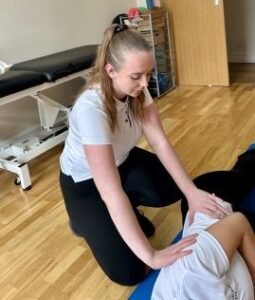
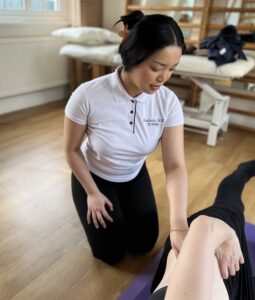
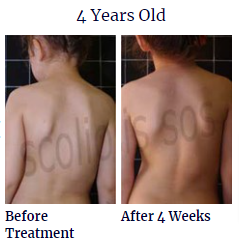
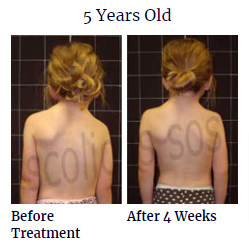
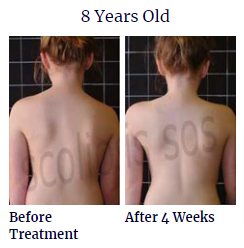
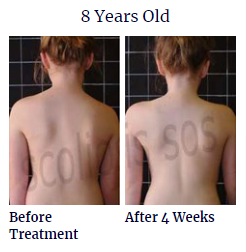
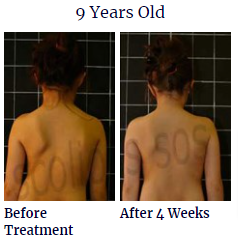
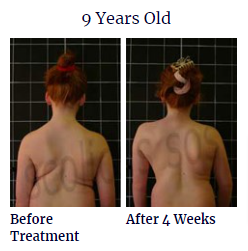
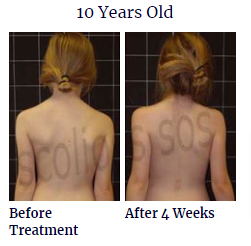
Here at the Scoliosis SOS Clinic, we treat scoliosis sufferers of all ages using the ScolioGold method, our own physical therapy programme that combines a wide variety of proven non-surgical techniques.
Each treatment course is tailored to the patient’s specific condition, and ScolioGold therapy helps to reduce pain and improve strength and muscle balance while also reducing the Cobb angle. Take a look at some of the results we’ve seen in our youngest patients:
How can parents and caregivers support children with scoliosis?
Supporting your child through their scoliosis journey means giving them the attention and care that they need.
Here at Scoliosis SOS, we offer scoliosis treatment courses that are tailored to the patient’s individual needs and goals, as well as in-person and virtual therapy sessions to help children manage and improve their scoliosis at their own pace.
Case Study: Sara, 9 Years Old
Sara was diagnosed with scoliosis at a young age after her older brother had undergone spinal fusion surgery for his own spinal curve.
Watch this video to hear how we reduced Sarah’s scoliosis angle from 17° to just 4°:
If you are interested in reducing your child’s spinal curvature and enhancing their wellbeing, contact us today to book a consultation with our scoliosis specialists.