Scoliosis SOS

Our Customers Say | Excellent     4.9 Out of 5 based on 875 reviews 


Why Do I have Uneven Muscle Growth at the Gym?

Why Do I have Uneven Muscle Growth at the Gym?

If you’ve been going to the gym and have noticed asymmetries in your muscle growth, you be confused as to why, especially if you are training bilaterally. Whilst no body is perfectly symmetrical and muscle imbalances can vary based on dominance, it may be worth considering if scoliosis is involved. Scoliosis is the lateral curvature of the vertebral column, but affects more than just the spine.

Muscular imbalances are common in scoliosis due to the three-dimensional nature of the condition, which involves changes such as vertebral shifting and rotation. The muscles on the convex side of the curve tend to become lengthened and overworked, while those on the concave side are often shortened, tight, and less active. 

People with scoliosis who regularly go to the gym may find that their muscular imbalances become more pronounced over time. This is not necessarily due to incorrect use of gym equipment, but rather the pre-existing imbalances associated with scoliosis.

FAQ’s

I have noticed muscular imbalances, what should I do?
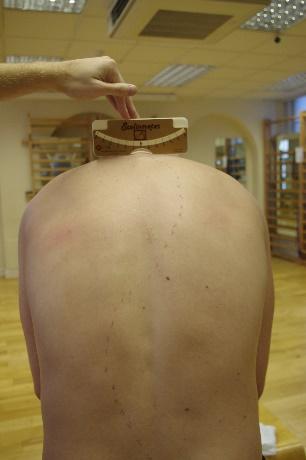
There are a number of reasons why you might be experiencing some asymmetries in your back muscles. However, scoliosis may be the cause of the muscular imbalance if you have also noticed other concerns, such as one hip rising higher than the other or one shoulder falling forward. The Adam’s Forward Bend Test is a simple screening method that can help identify signs of spinal curvature. If you notice any prominences during the test, it is recommended that you seek an assessment for scoliosis.

Muscle imbalances in scoliosis occur when one side becomes overworked and tight, taking on more of the load than the other side, which remains underused and weak. The muscles that are overused have reduced blood flow and elasticity, meaning that the tissue health has declined and there is an increased risk of injury. Continuing to train with muscle imbalances can also result in pain, compensatory overload, and reduced mobility.

We recommend avoiding types of heavy lifting, twisting movements, and other exercises that place excessive pressure on the neck and lower back. Stretches such as the cobra stretch often compress the lower back, for example. Avoiding overhead heavy lifting is advised if there are no existing interventions in place to protect your spinal health.

Exercises that may be beneficial for individuals with scoliosis include both asymmetrical and symmetrical strengthening exercises, as well as specialised approaches such as the Schroth Method or ScolioGold Method. Core strengthening can also help improve stability, posture, and overall muscular support. As all curve patterns are different, it is vital to see a specialist who can advise according to your presentation.

Final Thoughts

If you are concerned about uneven muscle development, or other asymmetries in your body, contact one of our team today. We can then provide specialist postural assessment and advice on treatment.

📞 02074884428
🌐 www.scoliosissos.com
📷 @scoliosissosclinic
📧 enquiries@scoliosissos.com
📍 63 Mansell Street, London, E1 8AN (headquarters)