4.9 Out of 5 based on 875 reviews

What is Functional Scoliosis?
Functional scoliosis is when the spine curves sideways due to underlying conditions such as muscle imbalance or leg length difference. Unlike structural scoliosis, the spine doesn’t have any structural changes. The spine may appear curved when standing, but straighten when bending forward.
Can Functional Scoliosis Get Worse?
Although it is often temporary it can potentially progress to structural scoliosis if not addressed or if the underlying cause persists. The body’s adaptation to these temporary imbalances can lead to permanent structural changes in the spine, including increase in rotation and progressed curvature.
How Can Functional Scoliosis be Measured?
Adam’s Forward Bend Test
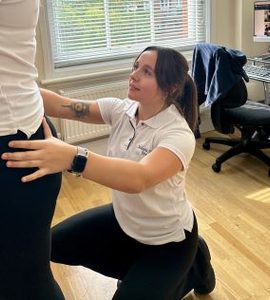
The patient bends forward at the waist with feet together, arms hanging, and knees extended. Things to look out for is spinal asymmetry, scapula asymmetry, unlevel hips, and a rib hump,
Scoliometer
While the patient is in the Adam’s Forward Bend position, a scoliometer can be used along the spine to assess the degree of rotation. A reading of less than 5 degrees typically indicates a functional, rather than structural, scoliosis.
Cobb Angle
Another way we can to assess the type of scoliosis is through an X-ray, where the Cobb angle is measured. If it is less than 10 degrees it is considered non scoliotic and a functional curve.

Signs and Symptoms of Functional Scoliosis
- Visible shoulder or hip asymmetry
- One side of the ribcage or lower back may appear more prominent
- Tightness on one side of the back
- Overactive muscles compensating for imbalances
What Treatment/Care Should Someone with Functional Scoliosis be Receiving?
If you are someone who have signs of a functional scoliosis it is very unlikely, you’d be recommended surgery. It is important to focus on addressing the underlying cause. Education on correct posture during sitting, standing, and walking. Use of shoe inserts or orthotics if you have a leg length difference or gait issues. Scoliosis specific exercise if there is muscle imbalance to strengthen and avoid progression. Here at Scoliosis SOS, we use specialised equipment such as the Formetric Scan and PedoScan to help identify the underlying cause of your scoliosis.
Formetric Scan
A non-invasive, radiation-free 4D surface imaging technique used to assess the alignment and posture of the spine and back. It measures the rotation, shoulder and trunk alignment and postural asymmetries.

PedoScan
The Pedoscan is a diagnostic tool used to assess foot pressure distribution and gait patterns. It helps identify issues such as uneven weight distribution, shifts in the center of pressure, muscle imbalances or weaknesses, and changes in foot posture. By analysing the Pedoscan results, we can determine whether the individual may benefit from orthotics.

Final Thoughts
Functional scoliosis, while often temporary, should not be overlooked. If left unmanaged, it can progress into structural scoliosis, leading to more permanent spinal changes. Early detection and intervention are essential. By identifying and addressing the root cause whether it’s muscle imbalance, poor posture, or leg length discrepancy treatment can be both effective and preventative.
Understanding these underlying issues enables us to provide tailored, non-invasive treatment plans. This might include posture correction, orthotics, or scoliosis-specific exercises all aimed at restoring balance, relieving symptoms, and preventing the condition from worsening.
By using objective, technology-driven assessments in an initial consultation, we can ensure that each patient receives the most accurate diagnosis and the most appropriate care for their individual needs.
📞 02074884428
🌐 www.scoliosissos.com
📷 @scoliosissosclini
📧 enquiries@scoliosissos.com📍 63 Mansell Street, London, E1 8AN (headquarters)