4.9 Out of 5 based on 875 reviews

Scoliosis is a progressive condition of the spine with 80% of cases being adolescent idiopathic scoliosis (AIS). This means that throughout puberty, a child develops a curve in their spine and this progresses with their growth. This is where bracing can be applied and is why early identification is essential in the effectiveness of bracing.
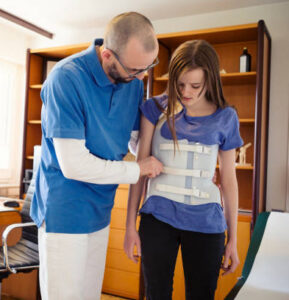
Scoliosis bracing is designed to manipulate the position of the spine into a more central position to guide the formation of the spine throughout growth. As a result of this, bracing eligibility is typically reserved for those who are not yet skeletally mature (not finished growing). As well as this, to qualify for NHS bracing your curve must have a cobb angle greater than 25 degrees and no bigger than 40 degrees when measured from a standing weight bearing x-ray. However, if the curve is smaller or larger than this you may still be eligible for private bracing and is still a good idea to explore this option to consider the best treatment available to you.
Bracing goals:
- Preventing curve progression
- Avoiding surgery or preparing for a less invasive surgery (less fusion required).
- Supporting the growth of the spine and symmetry of the posture.

Scoliosis bracing is a non-invasive treatment method for scoliosis and are proven largely effective for individuals with adolescent idiopathic scoliosis.
Full time Bracing:
- 18-23 hour per day
- Moderate curves 25-45 degrees
- Risser 0-2 (early growth stages)
- More effective on flexible curves
- BRAIST Trial showed up to 75% success rate in preventing surgery when braces were worn as prescribed.
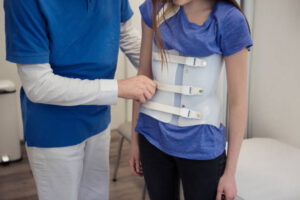
Part-time / Night time Bracing:
- Less than 18 hours per day
- Milder curves 20-35 degrees
- Patients closer to skeletal maturity with more stable curves
- More effective for smaller curves and single curvatures.
They key take home for bracing is that compliance matters! Both to wearing the brace but also to your scoliosis specific exercises. Due to the prolonged wear if you do not keep on top of your exercises there is a risk that your curve may progress due to the weakened structures of your back and spine.
Types of bracing:
Unfortunately, there is a disparity between NHS funded bracing and private bracing. With private orthotic practices being able to over correct the spine and apply a greater degree of curve correction than typical NHS Boston or TSLO Style bracing. Private bracing styles are much more over corrective in nature and aim to achieve at least a 50% correction to the cobb angle. With styles including Cheneau, Gensingen, RSC, ScoliBrace, and Providence nighttime brace. Additionally, standard waiting times for NHS bracing can range from weeks to often months where progression can often occur. With private bracing being much faster paced with braces being designed, fitted and supplied in as little as 1-2 weeks. In an ideal world, more people would have access to private style bracing and the high level of support that comes alongside this. Yet the main barrier would be the cost. Private bracing typically costs £2,000-£5,000 depending on type and adjustments required.
Am I Eligible for Bracing?

To find out more about bracing or if you feel that you may be suitable for a brace please get in touch and we will be happy to help refer you accordingly.
📞 02074884428
🌐 www.scoliosissos.com
📷 @scoliosissosclinic
📧 enquiries@scoliosissos.com
📍 63 Mansell Street, London, E1 8AN (headquarters)