4.9 Out of 5 based on 875 reviews

If you’ve been diagnosed with scoliosis or suspect you might have it, or another spinal condition, visiting the Scoliosis SOS Clinic for the first time can be both exciting and a little nerve-wracking. Understanding the process ahead of time can help alleviate any concerns and ensure you’re prepared for the steps involved. At Scoliosis SOS Clinic, the focus is on providing comprehensive, personalised care to treat spinal conditions effectively and non-invasively.
This guide will walk you through what to expect during your initial consultation visit, from consultation procedures to diagnostic tests and how treatment planning unfolds.
Initial Consultation: What to Expect

A Comprehensive Medical History
Your visit to the Scoliosis SOS Clinic, typically begins with a review of your medical history. This helps ourscoliosis specialist understand your condition more thoroughly. You’ll be asked to provide information about your symptoms, past medical history and any prior treatment or surgeries.
Expect to answer questions like:
- When did you first notice symptoms of scoliosis?
- Have you experienced pain or discomfort in your back?
- Have you had any treatment for your back in the past?
This information is crucial for our specialists to assess the potential severity of your condition and begin planning your treatment accordingly.
Physical Examination
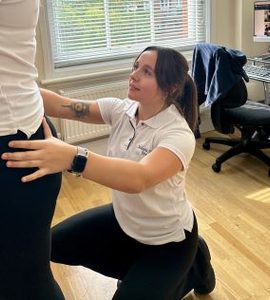
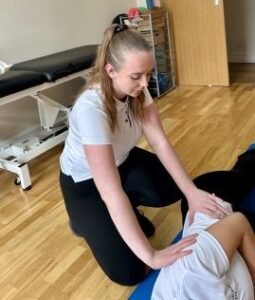
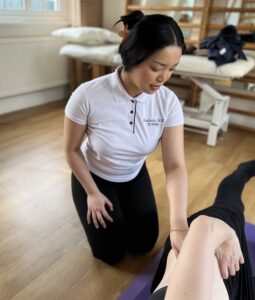
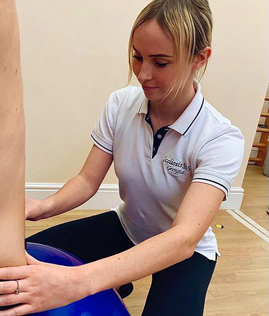
After reviewing your medical history, the next step in the consultation is a physical examination. During this part of the visit, your scoliosis specialist will visually examine your back to identify any obvious signs of a curvature. During this examination your specialist may ask to touch your back and you may be asked to bend forward so they can check for spinal deformities using a simple technique known as the Adam’s Forward Bend Test. Your scoliosis specialist will assess the alignment of your spine and if your posture is being compromised, providing a clearer picture of how your condition is impacting your health. After this initial examination has been completed, you will then undergo some diagnostic tests to help us with understanding your condition in more detail.
Diagnostic Tests: Understanding Your Condition

Scoliometer
YourScoliosis SOS Consultant might ask to conduct a Scoliometer reading of your back – a device that measures the rotation of your spinal curvature whilst you bend forward, this can be done in standing or sitting. Assessing the rotation withinyour back helps us to evaluate the severity of a curvature.
Diers 4D Formetric Scan

One of the diagnostic tools that you may encounter at the Scoliosis SOS Clinic is the Diers 4D Formetric Scan. This advanced technology provides a non-invasive, radiation-free, detailed 3D analysis of your spine, which is essential for accurately diagnosing scoliosis and tracking its progression over time.
The Diers 4D Formetric Scan uses advanced optical technology to scan the surface of your back and create a 3D image of your spine. The process is quick, painless and provides a wealth of information that helps us to gain a deeper understanding of the severity and characteristics of your spinal curvature.
During the scan, you will be asked to stand upright in front of the scanning devicewith your whole back visible to the camera. During the scan the lights will be turned off and you will be asked to stand still, in your relaxed posture for roughly 10 seconds whilst the scan is being taken.
You will be given a copy of your 4D Formetic Scan to take home with youand to help patients and their families better understand their condition, an education talk will be provided during your visit by your consultant. This talk will identify the findings from your physical examination and diagnostic testing. We believe that knowledge is key to managing your condition
Treatment Planning: Your Path to Better Spinal Health

The information gathered from your medical history, physical examination and diagnostic tests will guide this process. Whether your scoliosis is mild, moderate, or severe, the treatment plan will be tailored to meet your specific needs and goals. We have a variety of treatment plans available for those who don’t have Scoliosis and present with other spinal conditions, deformities or postural imbalances. There is a treatment option for everyone!
Understanding the Treatment Plan
The treatment plan will depend on several factors, including:
- The severity of your scoliosis
- Your age and development stage
- Symptoms and lifestyle impact
Non-Surgical Treatment Options

At Scoliosis SOS, we specialist in using effective, non-invasive treatment techniques to manage spinal conditions and improve spinal alignment. Our ScolioGold therapy aim to addressmuscular imbalances and improve posture, which is essential in preventing Scoliosis from worsening. Our goal is to always improve your spinal health, alleviate discomfort, and prevent further worsening of your condition.
Your scoliosis specialist will guide you through each step of the process during your initial consultation, ensuring that you understand your options and feel empowered to make decisions about your care. With a tailored, comprehensive treatment plan, you’ll be on the path to better spinal heath and a more active, pain-free lifestyle.
Make That Next Step Towards A Better Back
Ready to book your Initial Consultation appointment? Request a callback from our Patient Care Team or call us today on 0207 488 4428.