4.9 Out of 5 based on 875 reviews


When someone has been diagnosed with scoliosis, usually they will hear the words ‘cobb angle’ mentioned. The cobb angle is a number (measured in degrees) taken from an X-Ray which would normally be highlighted in an X-Ray report or shown on the X-Ray itself. The Cobb angle is one of main ways that specialists or clinicians can determine the severity of the scoliosis.
What Exactly is a Cobb Angle?
The Cobb Angle is used to classify patients into categories from mild to severe to distinguish the severity of their scoliosis. This number can help monitor curve progression over time and allow specialists to make decisions on treatment. Although the Cobb angle identifies the size of the curve, it does not tell us how much of an impact it has on one’s everyday life. This can be down to other factors such as pain or mobility, which are not always relative to the curve size.
How is a Cobb Angle measured?
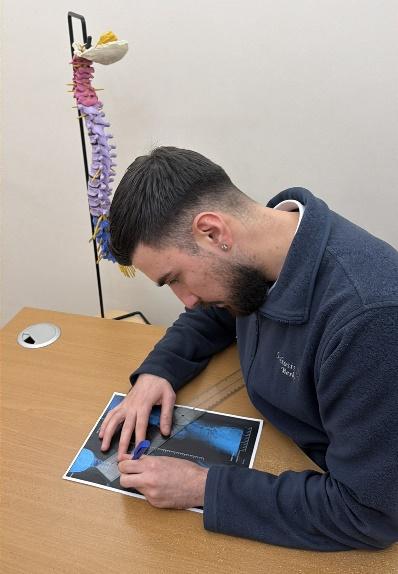
The Cobb Angle can only be calculated from a standing full spine X-Ray, not from an MRI or a CT scan. From the X-Ray, the most tilted vertebrae at the top and bottom of the curve must be identified, by finding the vertebrae with the steepest skew. Lines are then drawn from along the top of the above vertebrae and from the bottom of the below vertebrae in towards the concave side of the curve. Once the lines intersect, an angle can then be measured. If the lines do not meet, perpendicular lines will be drawn off of the original lines, and the angle of their intersection will then be used as the Cobb Angle.
Why is the Cobb Angle Important?
The Cobb angle is an important way of measuring scoliosis development over time due to its progressive nature, especially for younger children or teenagers who are likely see changes as they grow. The Cobb Angle provides an accurate way of describing a spinal curvature, although other factor such as age, symptoms and skeletal maturity should also be considered when understanding an individual’s scoliosis. The Cobb Angle also only considers scoliosis in two dimensions, in the frontal plane, but it is well established that scoliosis more than just the lateral curvature of the spine, but also the sagittal rotation (twisting) of the spine too. This signifies the need for multiple measurements to monitor scoliosis progression.
Scoliosis Severities Based on Their Cobb Angle
A Cobb Angle that is below 10 degrees is considered non-scoliotic, as no body is perfectly symmetrical. However, once the spine curves at an angle greater than 10 degrees, clinicians may refer to the follow thresholds for categorising severity.
- <10 Degrees – Non-scoliotic
- 10-24 Degrees – Mild scoliosis
- 25-40 Degrees – Moderate Scoliosis
- >40 Degrees – Severe Scoliosis
It is noteworthy that correlation and causation are not the same, so curve severity does not automatically determine effects on pain, mobility, or quality of life.
Treatment Recommendations According to Cobb Angles
The Cobb Angle is mostly used as a guide to decide appropriate treatment recommendations.
For mild curvatures between 10 and 24 degrees, the treatment approach is often circumstantial in relation to patients age and level of skeletal maturity. The observational approach is frequently taken for younger patients to monitor progress, such as with X-Rays every 3-6 months. Older patients would typically be discharged form the NHS. In moderate curvatures of 25 to 40 degrees, progression will continue to be monitors for most patients, and conservative treatments such as scoliosis-specific exercises (SSE),, with potential additional bracing for younger patients, are advised. In severe cases, currently being quantified by a curvature over 40 degrees, the aforementioned conservative measures will continue, but in some cases, surgery may also be considered but with consideration to your lifestyle factors and goals.
Treatment is always a recommendation, the choice to use a brace and/or consider surgery is yours.

FAQ’s
What is a Cobb angle?
The Cobb Angle is a measurement taken from X-Rays to help healthcare professionals to gain a better understanding on the severity of the curvature.
I have a 9-degree cobb angle, what does this mean?
A Cobb Angle below 10 degrees considered non-scoliotic. It is normal for spines to be imperfect and not entirely symmetrical. If this angle increases beyond 10 degrees, then it may be considered scoliosis, and a healthcare professional will guide you on treatment options based on the severity.
Can a Cobb angle change over time?
Yes, a cobb angle can both increase and decrease over time depending on lifestyle. X-Rays and Cobb angle measurements are important to monitor, especially during the rapid growth stages in adolescence. Scoliosis is a progressive condition by nature, meaning that without intervention, it can increase at a rate of 1-2 degrees per year. However, with appropriate intervention, such as scoliosis-specific exercises (SSE), this can slow down, or even reduce the changes in the Cobb Angle.
Final Thoughts
The Cobb angle is a very important measurement tool used to gain information on the severity of the scoliosis and if there is any change over time. However, the degree of curvature is not a direct indication on other factors such as pain, mobility, and effects on everyday life. This is why these factors should also be considered when monitoring scoliosis over time.
If you do have any concerns about your Cobb Angle or scoliosis, speaking to a specialist can be beneficial for understanding more about the condition and analysing future treatment options.
📞 02074884428
🌐 www.scoliosissos.com
📷 @scoliosissosclinic
📧 enquiries@scoliosissos.com
📍 63 Mansell Street, London, E1 8AN (headquarters)